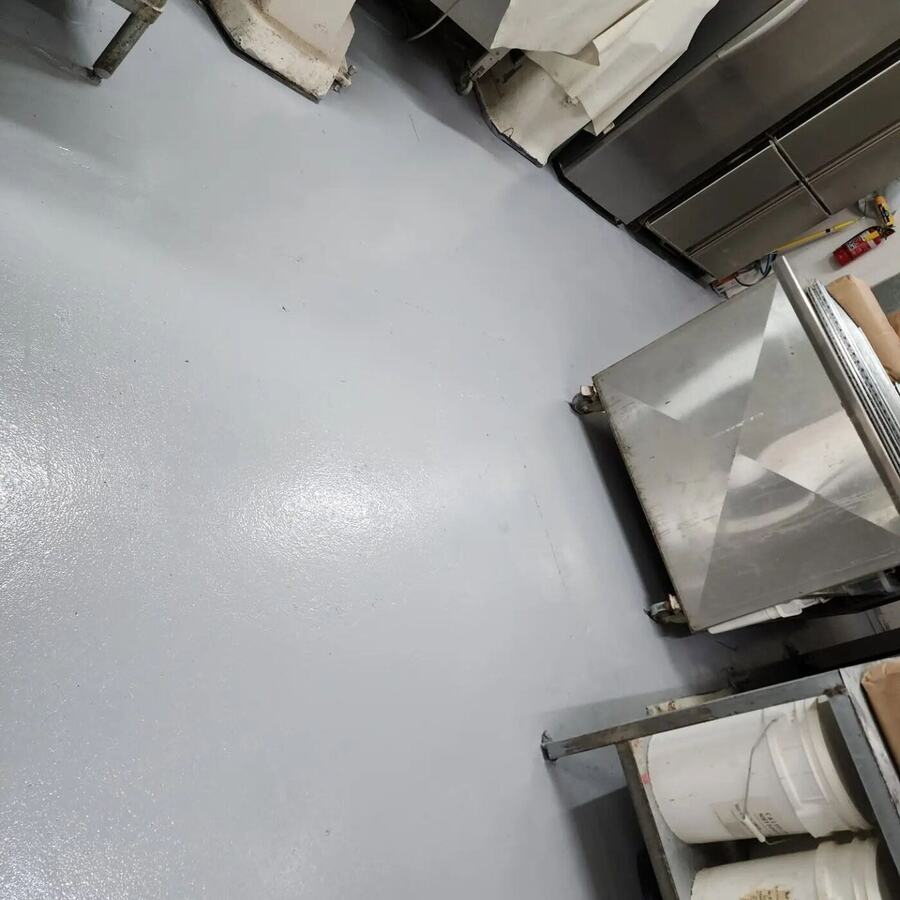
If you are fitting out a cafe, restaurant or small food production space, the floor is one of the first things a council environmental health officer will look at. So the question comes up early: is epoxy flooring good for a commercial kitchen? In most cases it is, provided it is specified and installed for wet, greasy, hot-water conditions. Here is what Victorian council guides actually ask for, and how a resin floor answers each point.
One caution first. Victoria has no single prescriptive list of floor specifications, and each council interprets its guide through its own officers. Surf Coast Shire's fit-out guide says it is aligned with Standard 3.2.3 of the Food Standards Code and Department of Health guidance, and the examples below come from council guides in Surf Coast and Wyndham. Check your own council's guide, and send plans before work starts.
What the guides say about food premises floors
Surf Coast Shire's guide says floors in a new food business should suit the area, be easy to clean, be unable to absorb grease, food particles or water, be laid so water does not pond, and give pests nowhere to live or hide (Surf Coast Shire). Wyndham City Council's guidelines say floors must be smooth, waterproof and durable with no open joints, and they list epoxy resins among the acceptable materials alongside sealed quarry tiles, ceramic tiles with epoxy grout, vinyl sheeting and laminated plastic sheeting (Wyndham City Council).
That list matters because it shows tiles can pass too. The difference is maintenance. Grout lines are joints, and joints are where grease and moisture collect over a few years of daily wash-downs. A seamless resin floor has none. Our food-grade systems are seamless and non-porous, built to cope with grease, oils, sanitising chemicals and hot-water wash-downs, which is the work a kitchen floor does every night.
Coving
The wall-to-floor junction is the hardest corner to clean in any kitchen. Surf Coast recommends coving in food handling areas to stop grease, dirt and food building up in corners. Wyndham asks for sealed coving that runs up walls and partitions to 75mm with a concave curve, and it advises against aluminium, feather-edge or plastic strips laid on top of the floor because food can get trapped underneath.
That last point is a good argument for a resin cove over a stuck-on strip. The cove is formed from the same material as the floor, so the floor and the lower wall are one continuous surface. We install coved skirting to walls and drains where required as part of the food-grade scope.