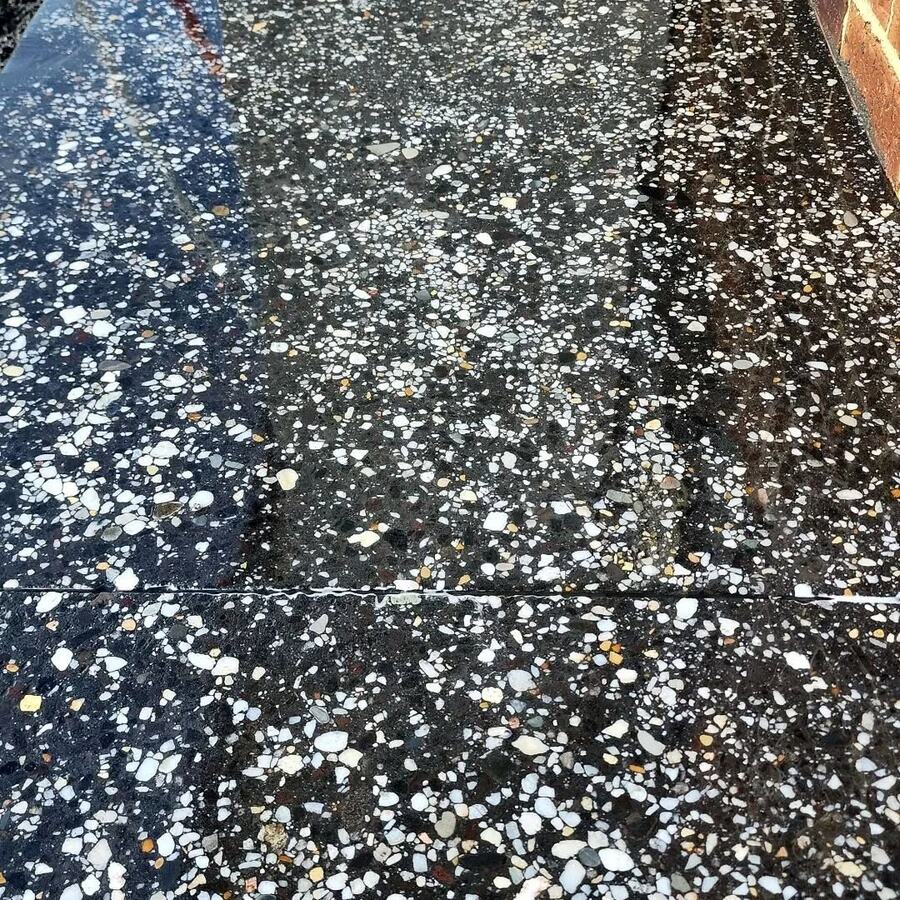
People ask whether epoxy flooring is slippery, and the honest answer is that it depends on how it is finished. A smooth, glossy epoxy floor with water or oil on it can be slick. The same floor with aggregate broadcast into it and a textured topcoat can grip well. For a business, the useful question is not whether epoxy is slippery but what level of grip the floor needs and how to prove it has it. This guide covers that for commercial and industrial sites.
How slip resistance is measured
WorkSafe Victoria's guide, Preventing slips, trips and falls at work, points to two standards. AS 4586-2013 sets standardised test methods for the slip resistance of new pedestrian surfaces, and AS 4663-2013 does the same for existing surfaces already in place (WorkSafe Victoria). The guide says to check the rating from the supplier when choosing a floor.
A drainage manufacturer's summary of AS 4586 explains the ratings. The wet pendulum test gives a P rating from P0 to P5, where P5 grips best. It replaced the older V to Z classes in the 2013 edition, and the newer rubber slider is meant to resemble a worn, polished heel, so high ratings are harder to reach. There is also an oil-wet inclining platform test that produces an R rating from R9 to R13, which matters wherever oil or grease reaches the floor (ACO).
The same summary says SA HB 198, the handbook that goes with the standard, suggests minimums for different areas. Its examples include P3 and R10 for undercover car parks and P5 and R12 for commercial kitchens and undercover loading docks. That is a secondary source, so treat the numbers as a pointer and confirm them against the handbook or your building surveyor before specifying.
Rating is not the whole story
WorkSafe makes a point that surprises many people. Slip resistance is not only a property of the material. The guide says it is also affected by wet or dry conditions, the activity, the footwear, contamination and how well the floor is cleaned. It gives an example of an external hospital ramp that met the relevant standard but still carried a higher slip risk because of the slope, regular rain, heavy trolleys, worn shoe tread and poor cleaning.
For a business, that means a rating certificate is a starting point. A floor can pass a test when new and become slippery if it is under-cleaned, if oil is tracked across it, or if the texture is worn flat by forklift traffic. WorkSafe's guide notes that a deep clean is often needed to restore a floor to its original grip, and that grip treatments should match the rest of the floor so people are not surprised by a sudden change underfoot.
How a commercial epoxy floor gets its grip
There are three common ways, and they can be combined.
- Anti-slip additive in the topcoat: fine particles mixed through the clear coat give a light texture. This suits dry warehouse floors and offices where cleaning matters more than extreme grip.
- Broadcast aggregate: quartz or similar aggregate scattered into the wet body coat and sealed in gives a stronger, more aggressive texture. It suits wet or greasy areas, ramps and wash-down zones.
- Flake or quartz systems: decorative broadcast systems add texture as part of the build, and can be topped with an anti-slip topcoat where needed.
Our food-grade systems include an anti-slip additive for wet, greasy areas, and our site lists anti-slip rated systems for wet and high-traffic spaces. The trade-off is simple. More texture gives more grip and takes more effort to clean, because dirt sits between the particles. A commercial kitchen and a dry parts store need different answers.
Matching grip to the area
For commercial kitchens and food prep, grease, hot water and daily wash-downs call for an aggressive texture, with a formed cove and falls to drains. See our post on epoxy floors in commercial kitchens for the council side of this.
Loading docks and covered aprons get rain blown in, tyres tracking water and oil, and forklifts braking hard. A durable broadcast system suits them, and they need regular cleaning.
In workshops and manufacturing, oil is the main contaminant. The oil-wet R rating is the one to ask about, and chemical-resistant full flake systems are listed in our industrial floor coatings range.
Showrooms and offices are usually dry, so a smoother, higher-gloss finish with a light additive often does the job. Wet entrances, such as a front door on a rainy spring afternoon, are the exception and deserve a more textured section.
What to ask your installer
- What rating does the proposed system carry, from which test, and on what product?
- Was it tested wet, oiled, or both?
- How will the floor be cleaned, and by whom?
- What happens to the texture under forklift traffic?
- Can the finish change between zones, for example smooth in a dry aisle and textured at the dock?
Spring is a good time to review this. Rain and wash-downs show you where the floor is slippery before summer storms and the busy pre-Christmas period do. If you are unsure whether an existing floor is a risk, a slip test on the existing surface under AS 4663 is a job for a testing consultant. We can tell you what finish suits the area when we inspect it. Our commercial flooring page lists the sites we work with, and our Craigieburn commercial page covers one of the industrial areas we quote in regularly.