
Melbourne's #1 Rated Epoxy Flooring · Call 0481 847 597

How Long Does Epoxy Flooring Take to Cure? Planning a Commercial Floor Shutdown in the New Financial Year

Light traffic, full traffic and chemical cure are three different dates. What data sheets say, and how to plan a floor shutdown now that the new financial year has started.

Empty factory floor with columns, showing the space a floor upgrade shutdown has to clear
An empty factory floor with columns. Stock photo, not an SSA job. Photo by Aneta Zelenková on Pexels

How long does epoxy flooring take to cure? The honest answer is that it is not one number. A floor passes through several stages, each with its own date, and every one of them moves with temperature. For a business that has just started a new financial year with a floor upgrade on the list, those dates decide how long the site is out of action. This guide explains what data sheets say, how mid-winter weather stretches the programme, and how to plan a shutdown with realistic dates.

Three dates, not one

Data sheets separate the stages. A Fosroc fact sheet for a polyurethane cement flooring system gives light traffic at 36 hours at 10°C, 24 hours at 20°C and 12 hours at 30°C. Full traffic is 72, 48 and 24 hours at the same temperatures, and full chemical cure is 12 days, 7 days and 5 days (Fosroc). A Dulux data sheet for a water borne epoxy shows the same pattern. At a floor temperature of 10°C it allows light traffic after 48 hours, against 24 hours at 25°C, and the minimum wait before recoating is seven hours instead of four (Dulux Protective Coatings).

Three dates matter to a business. The first is when people can walk on it. The second is when pallet jacks, forklifts and vehicles can use it. The third is when it can take chemicals, hot water or heavy cleaning. A floor can be open to foot traffic and still be days away from the date a spill or a wash-down is safe, and the paper schedule needs all three.

What winter does to the programme

The Bureau of Meteorology's summary for Greater Melbourne in July 2026 reports a mean daily maximum of 14.3°C and a mean minimum of 5.7°C at Melbourne Airport, with the coldest morning at 0.1°C on the 6th. At Wallan (Kilmore Gap), north of the city, the mean maximum was 9.7°C (Bureau of Meteorology). Those are air temperatures. A slab in an unheated shed is often colder than the air, and the figures sit at or below the 10°C column of the data sheets above.

The Sika sheet for an epoxy coving mortar shows the extremes. Its minimum overcoat time is about 24 hours at 10°C, 8 hours at 20°C and 5 hours at 30°C, and it needs about 10 days at 10°C before normal traffic or chemical exposure compared with 5 days at 30°C (Sika). A job that is a four-day shutdown in March can stretch into a second week in August. The sheets are laboratory figures and a site will not match them, so treat them as a guide for questions.
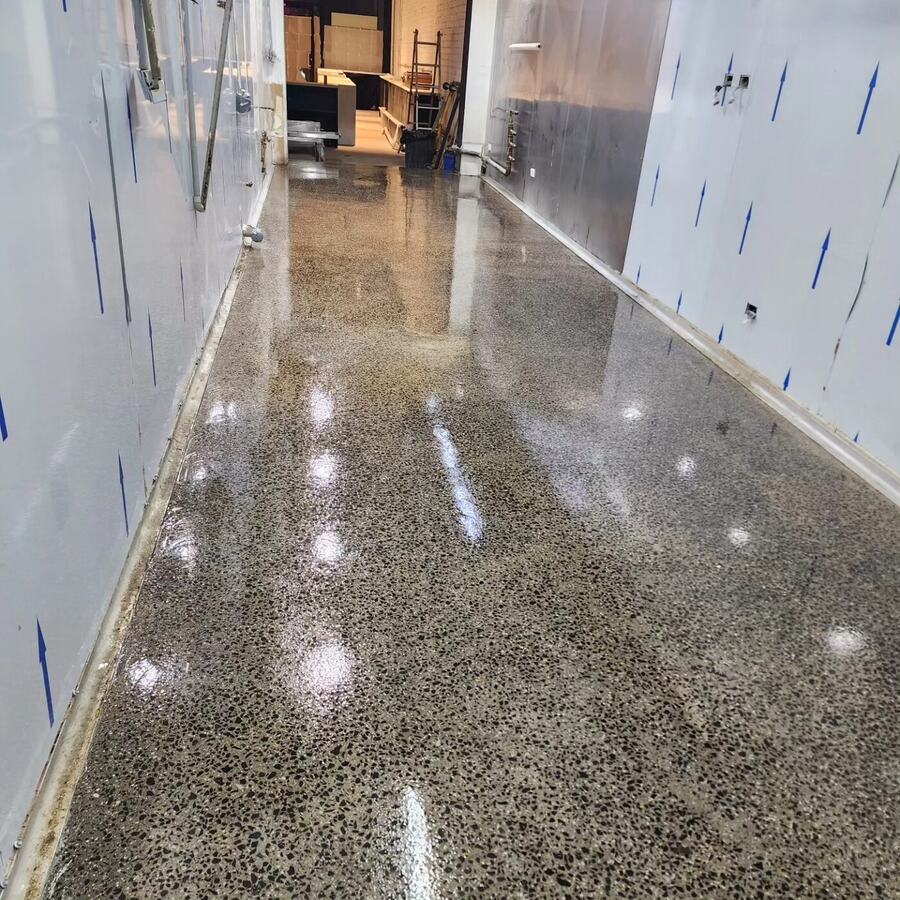
Finished commercial corridor floor with a glossy sealed finish
A finished commercial corridor floor with a glossy sealed finish.

Why the new financial year is a good time to plan

For many Australian businesses, 1 July resets budgets and approvals. Money that could not be spent last year is now on a plan, and a floor that has been a nuisance for months becomes a line item. Planning in July and August has a practical benefit too. A shutdown does not need to be in the next fortnight, and a window in spring, when slabs are warmer and cure times shorter, can be worked towards now. How a floor upgrade is treated in your accounts is a question for your accountant, not for us.

Building a shutdown plan

What to ask in the first conversation

Tell the installer what the floor has to do, when the shutdown window is, and what cannot stop. In return, ask how site temperature will be logged, what happens if conditions fall outside the data sheet limits, and what the plan is if a coat misses its window. Our guide to commercial warehouse flooring sets out the usual system, and those in Mickleham and the north can look at our Mickleham commercial page.

If the dates do not fit your business, say so early. We would rather plan a staged job over several weekends than promise a short shutdown the weather will not allow. We inspect the site, give you a written scope and a fixed price, and back the work with a 7-year warranty.

Sources

By Sealing Solutions Australia · Published 6 Aug 2026

Questions people ask

It depends on the product and the temperature. One Fosroc sheet gives light traffic at 24 hours and full traffic at 48 hours at 20°C, with full chemical cure at 7 days. At 10°C those become 36 hours, 72 hours and 12 days.

Cure is a chemical reaction that slows as the slab gets colder. Data sheets list longer times at 10°C than at 20°C or 30°C, and a cold shed slab can be colder than the air.

The install is only part of it. Plan for light traffic, full traffic and chemical cure dates at your site temperature, and consider staging by zone to keep the rest of the site running.

Many businesses plan after 1 July, when new budgets start. Aiming for spring can shorten cure times, but start the conversation early and ask for a written schedule.

Want a number for your floor?

Free site inspection, written scope of work and a fixed price. Sammy Kocas calls same day.

📍 Commercial & industrial, all Melbourne

Free Commercial Quote

Site inspection within days.

🎉

You're All Set!

Thanks! We'll call you shortly to book a site visit.
In a hurry? 0481 847 597

🔒 No obligation. Free on-site quote.