
Melbourne's #1 Rated Epoxy Flooring · Call 0481 847 597

Anti Static Flooring for Electronics and Data Rooms: What Gets Tested and What to Ask

An anti static floor is only as good as the readings taken after it is installed. What the test standard measures, what one manufacturer asks of the slab, and the questions that belong in the scope.

Server racks lining an aisle with a concrete floor in a data centre
Server racks along an aisle in a data centre. Stock photo, not an SSA job. Photo by Brett Sayles on Pexels

Anti static flooring gets requested by electronics assemblers, repair benches, server and comms rooms, and labs. The request usually arrives as one line, "we need an ESD floor", and the scope that follows is where jobs go wrong. An anti static floor is not a colour or a product name. It is a measured electrical property of the installed surface, and it can be checked with a meter before anyone signs off. This guide explains what is measured, what the slab has to supply, and what to ask before a floor goes into a room full of sensitive equipment.

What the test standard actually measures

The international test method for floors is IEC 61340-4-1. Its scope says it covers the electrical resistance of all types of floor coverings and installed floors, including resistance to ground, point-to-point resistance and vertical resistance, across a range of 104 to 1013 ohms. The edition published in April 2015 combines the 2003 text with its first amendment. The IEC notes that laboratory tests under controlled conditions can support classification or quality control, while tests on installed floors can verify correct installation or support ongoing checks (IEC webstore).

Two points matter for a buyer. First, the standard is a test method. The 2015 amendment changed only the test methods and did not add classification or performance requirements, so the pass mark has to come from somewhere else, such as your equipment maker, your customer or your own ESD control plan. Second, there are different kinds of reading. Resistance to ground tells you how well the surface drains charge to earth. A point-to-point reading checks the surface between two electrodes. If a quote says "ESD compliant" and does not say which reading and which limit, ask which one was meant.

What a conductive system asks of the slab

Many conductive floors are built as a layered system, with a conductive primer at the base and a conductive or dissipative coat above it. One manufacturer's product page for a conductive epoxy primer is useful because it states plainly what the concrete must provide. It lists a typical resistance to ground of 104 ohms or less for the primer, and says readings can vary with temperature, humidity and measurement equipment. It specifies that product, air and substrate sit between 10 and 30 °C, with relative humidity no higher than 75 percent, and that the substrate stays at least 3 °C above the dew point (Sika).

The same page sets requirements for the slab itself. Cementitious substrates need a minimum compressive strength of 25 N/mm² and a minimum tensile strength of 1.5 N/mm². The surface must be clean and dry, free of oil, grease, old coatings and laitance, and prepared mechanically, for example by blasting, planing or scarifying. Construction joints and static cracks need pre-treatment, and the primer must not go onto a slab with rising moisture. None of that is unusual for a good coating job, but a conductive floor has less room for error, because a poor bond or a patch of contamination can change an electrical reading as well as the appearance.

This is one manufacturer's sheet, and we have not described it as the system we use. It is included because it shows the kind of detail you should expect any installer to be able to give you for the system they propose.
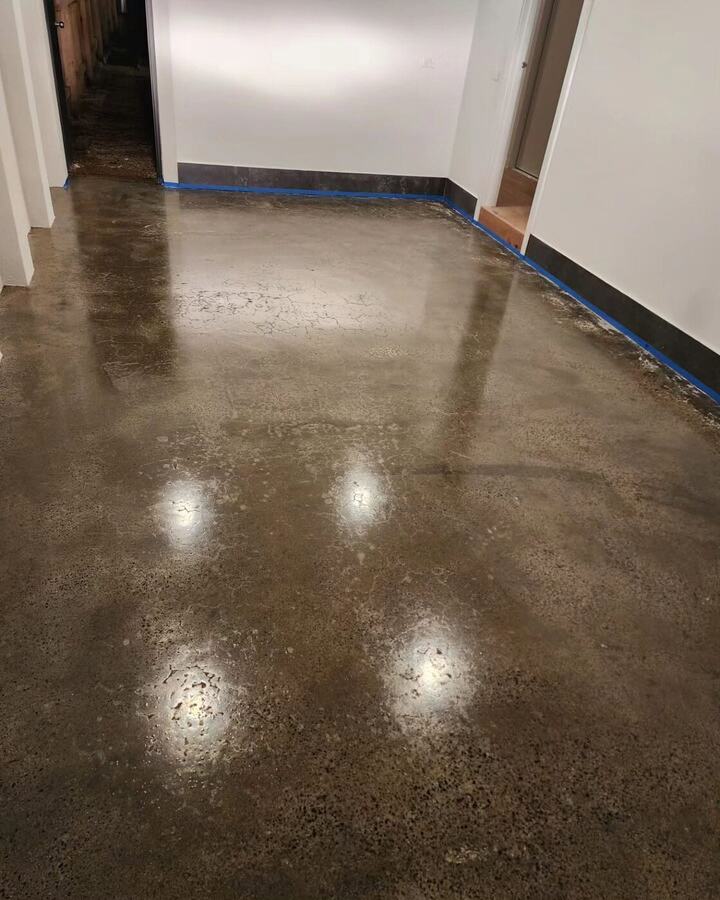
Glossy sealed concrete floor inside a commercial building with blue tape along the wall
A glossy sealed concrete floor inside a commercial building.

Earthing is part of the floor, not an extra

A floor that conducts has to be connected to earth. The same Sika page is direct about how not to do it. It warns that self-adhesive copper tape can make a floor highly conductive but may not comply with the VDE 100-610 safety rule, and says earthing points give no protective effect at the point itself or within about 10 cm of it. It says not to use self-adhesive copper tape to form conductive grids across the floor, to use only the earthing points supplied in the manufacturer's conductive set, and to mark and cover those points with a rubber mat rated above 1 megohm. Earthing layout is a design decision made before the first coat, so it belongs in the scope and on a drawing that an electrician can check.

Why the conditions on the day matter

The data sheet language about temperature and humidity is not boilerplate. Resistance readings move with the room. As Melbourne moves into winter, heated rooms are usually drier than the air outside, so ask when the final readings will be taken and under what conditions. Ask whether a second set of readings will be taken after the floor has been in service for a short period, because a floor that passes on handover day can drift once equipment, trolleys and cleaning products arrive.

What to settle before you request quotes

Fitting the work around the equipment

Electronics areas are hard to clear. Racks, benches and cabling are often fixed, so the job is usually staged room by room, with equipment moved in sections and the floor allowed to cure before it goes back. Plan the order of rooms and the access route for materials early. If the building has a data room that cannot lose power, say so in the first conversation so the installer can plan dust control and access around it.

Where we fit in

ESD and anti-static flooring is one of the services listed on our commercial epoxy flooring page, alongside warehouse, industrial, food-grade and line marking work, and anti-static options are noted on our commercial and warehouse page. Because the target resistance and the room conditions differ on every site, we do not give a number until we have seen the room and know the limit you need to meet, so please ask us. Businesses in Tullamarine and Epping can start with the local pages. We inspect the site, give you a written scope and a fixed price, and back the work with a 7-year warranty.

Sources

By Sealing Solutions Australia · Published 4 Jun 2026

Questions people ask

It is a floor whose electrical resistance has been designed and tested so that static charge drains away instead of building up. It is judged by readings such as resistance to ground, not by its name or colour.

IEC 61340-4-1 sets out test methods for resistance to ground, point-to-point resistance and vertical resistance in the range of 10 to the power 4 to 10 to the power 13 ohms. The pass limit comes from your own requirement, not from the test method.

Conductive and dissipative resin systems exist, and they are built up in layers over a prepared slab. Which one suits a room depends on the limit you must meet, so ask for the system data sheet and the readings that will be taken.

ESD and anti-static flooring is listed on our commercial epoxy page. Targets and conditions vary, so ask us for a site inspection and a written scope before assuming a system fits.

Want a number for your floor?

Free site inspection, written scope of work and a fixed price. Sammy Kocas calls same day.

📍 Commercial & industrial, all Melbourne

Free Commercial Quote

Site inspection within days.

🎉

You're All Set!

Thanks! We'll call you shortly to book a site visit.
In a hurry? 0481 847 597

🔒 No obligation. Free on-site quote.